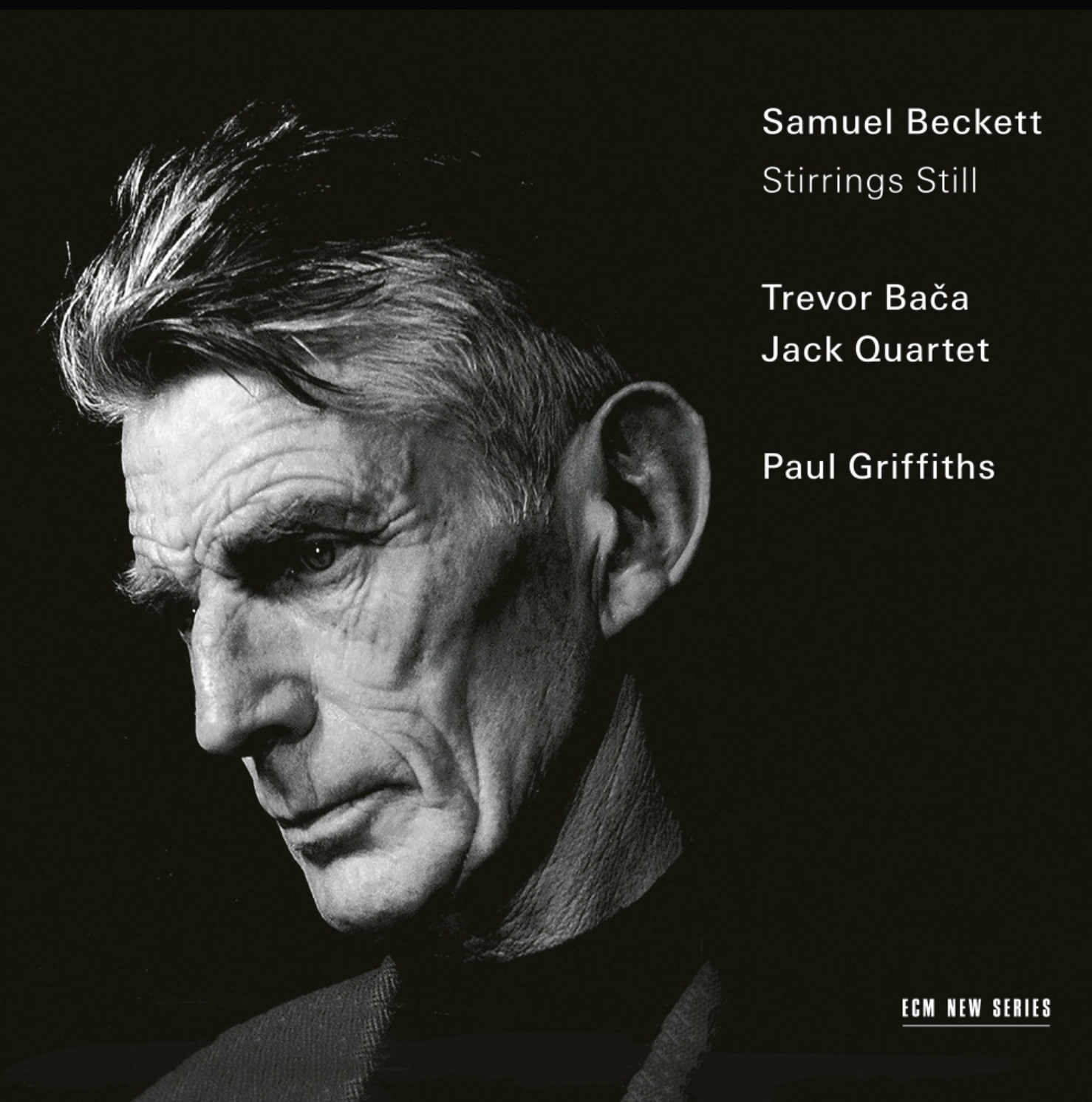
Stirrings Still (2016-18/2023/2026)

Composer: Trevor Bača.
Forces: narrator, vn, vn, va, vc.
Duration: 65 minutes.

Reflections on composing the work

I read Samuel Beckett’s Stirrings Still for the first time in 2016, after Paul Griffiths introduced me to the text. I knew Beckett’s plays but not his late prose, and what startled me when I began reading was not just what the text said, but how it moved.

Beckett's language continually circles back on itself. Images disappear and then reappear, altered. A sentence ends only to begin again. Small words — again, then — take on enormous structural importance. A word introduced at the end of a thought spreads backward through the memory of what has already been read, and then forward into what follows. And details accumulate: “night” becomes “night or day”; images return multiplied, carrying their earlier appearances with them.

I recognized these procedures. For some years I had been developing analogous ways of thinking about what happens in instrumental music: repetition in which the repeated thing is changed by the fact of its return; musical events that seem to remember earlier events; materials introduced almost invisibly and transformed much later; processes interrupted by fragments of their own past, or by intimations of their future. Beckett's words moved according to principles of change and transformation that were astonishingly close to ones I had been pursuing in music; it made the experience of reading uncanny.

I could hear music responding to the text, and the text animated by music. So I memorized the words, writing them out by hand until the circlings-back in the language felt completely fluent. I made concordances of recurrent words, images and actions: clocks and cries; seeing and hearing; head resting on hands; disappearance and reappearance; movements away from things, and the much rarer movements toward them. I tracked the extraordinary recurrence of again, the changing work performed by then, and the repeated prospect of an ending that continually fails to become the end.

Then I broke the text apart, printing fragments of it on papers pinned to the wall, reading through them over and over, searching out different ways of dividing up the words. What would we feel in a gap between words, right here? Or here? When does a break leave words suspended in memory? When does it produce anticipation? When do we search backward for an image heard earlier? What happens when words begin, disappear into music, only to reemerge minutes later?

In the end I divided Beckett’s three-part text into twenty-nine spoken fragments. The process never felt like setting words to music, but like some other type of setting: setting stones, the way a jeweler does, fragments placed at exact distances from one another, held apart and joined by another material. Music enters the spaces between words and dilates those spaces — sometimes enormously — without making the words cease to be themselves.

That independence became fundamental to the piece. The spoken text and the string quartet form two distinct streams. Neither explains the other, and neither is reduced to the function of accompaniment. Their relationship arises instead through proximity, memory, interruption, agreement, resistance.

The piece begins with words alone: “One night as he sat at his table head on hands he saw himself rise and go.” The quartet enters with a pair of chords, and already something has begun. The words have stopped, but remain active in memory. We imagine a beginning, head on hands, an act of self-seeing, a rising, a departure. The music therefore enters a state of mind in which those possibilities are still resonating. Perhaps the chords continue the action implied by “rise and go”; perhaps the words instruct music to begin; perhaps the music answers. However we choose to hear our way through the piece, a flock of different interpretations remains available at once.

This happens throughout Stirrings Still. Every passage from words to music, and from music back to words, creates a new field of interpretation because what has just disappeared remains present in memory. Again early in the piece, the text halts, suspended immediately after the word “open.” The music that follows is already pursuing a process of its own: the same pair of chords has been recurring, with the second of the pair gradually increasing in duration and changing in color. After “open” it stretches much further, resolving into the first of the held pitches in the cello, as though the chord itself has somehow opened from within. The music has its own reason for arriving here, yet the last word we hear remains intensely present while this transformation takes place. The two streams have momentarily found the same action, but by different means.

As the work proceeds, these moments contribute to a growing sense of entwinement. A sentence seems to arise from the music preceding it; a musical process seems to emerge from the words. A little later the relation appears reversed. We see exactly where every threshold occurs and yet become increasingly unable to decide which medium contains which. This is one reason the piece begins and ends with words alone. Beckett has the first word and, more than an hour later, the last. The music occupies an enormous space between those two boundaries, but these boundaries allow the music to be heard as something that has somehow arisen from within the movements of the words themselves.

The instrumental music develops through five broad families of material, each associated in my mind with a different kind of physical motion. One pronounces: dense chordal objects that enter with the force of declamation. Another circles: elliptical movements of the bow whose speed, size and pressure continually change. Another travels: elaborate multi-stage trajectories of glissandi that move across the four instruments, like the paths of birds in flight. Another flickers and hovers, in tremolo. The fifth seems almost to suspend motion altogether: long, dilated pitches opening onto strange harmonic fields built from the upper partials of cello multiphonics. I came to understand these not only as five kinds of sound, but as five ways for music to move.

Their transformations create one history inside the piece. Another, still more pervasive, history is created by the music’s relationship to its own past and future. Throughout Stirrings Still, the present is suddenly entered by another moment of the work. A process underway now contains a fragment heard much earlier. At another point, music that properly belongs far in the future appears before its time, like a premonition. These displaced moments themselves become nested: a recollection opens onto another recollection before both close and the present resumes.

The effect differs from ordinary thematic return because the stability of the present itself begins to change. Near the beginning of the piece, after a stretch in which the music has wandered increasingly far from its starting point, the pair of chords announced at the beginning of the piece suddenly returns. The sensation is, perhaps, something like coming to, after daydreaming or having lost the thread of conversation, only to find it again in an instant. Nothing had stopped our attention. Yet, suddenly, we seem to have returned to a moment in the music that somehow feels like the real present.

Beckett’s opening situation then returns as well: “One night or day then as he sat at his table head on hands he saw himself rise and go.” The words begin again, but not exactly. Night has become night or day: the image has multiplied. And then, almost invisibly, places us again in a present moment already altered by everything through which we have passed. Music and words have independently effected a return to their beginnings. But then, a measure later, the music refuses to remain there: the music slips backward again into a process of development from which it had apparently just escaped.

Following this moment one step further, Beckett’s text then moves through a sequence of rising, sitting, rising again and clinging to the table. And then this fragment of the text ends with two extraordinary words: “Then go.” An imperative reading enters, and the words seem almost to turn toward the music itself. The music goes. A new sound appears: short strokes distributed through the quartet that, privately, I thought of as the ticks of some never-identified clock. They mark time, first evenly, then in layers. And, later, they join in extended paths throughout the music, as though each measured point of time had acquired direction, and taken flight.

In moments like these, memory becomes one of the central materials of the piece. Beckett’s prose already carries an extraordinary burden of recurrence. Places, gestures, sounds and phrases return; something disappears only to reappear somewhere else; the possibility of an ending is repeatedly summoned and repeatedly deferred. The text is short, and yet by its conclusion it seems to have accumulated the movements, losses and repetitions of an entire lifetime. And in response to this, or alongside it, the music develops a comparable burden of memory. Small sounds return transformed into vast ones. A sustained pitch heard almost incidentally near the beginning becomes, much later, an overwhelming harmonic field. Isolated strokes join into trajectories. Earlier musical processes re-enter the present out of sequence, while future ones appear before we know what they are.

Because language and music perform these operations independently, their memories become interbraided. The words remember something from which the music has moved away. The music reopens a past that the text has left behind. One stream anticipates while the other remembers; elsewhere both arrive at the same action independently. Perhaps the deepest relationship between the words and music lies here: in two forms of consciousness moving through time, each charged by memory, each changing how the other is heard.

Across the course of an hour this accumulation becomes enormous. We have heard sounds begin, transform, disappear and return. Sentences have been opened and suspended; images have accumulated and dissolved. Past and future have repeatedly entered the present. Words and music have alternated, touched, resisted one another and seemed to emerge from one another. And then, near the end, the music begins an extended process of looking backward through this accumulated history. Earlier time returns with increasing intensity, and the effect is not one of summary but of relinquishment: the enormous world the piece has suggested begins to give itself up. Gradually the quartet disappears, and then only the words remain: “Time and grief and self so-called. Oh all to end.”

Nothing follows.

I remember hearing the way the final words fell on the last day of writing the piece. There was snow outside, and after so many months of work it became possible to hear this entire process of disappearance: all the events the piece had accumulated, all its memories and transformations and returns, relinquished until only the final words remained. In the middle of the reading room of the library that had been home to me and the piece while I wrote it, I looked up from the table and began to cry.

* * *

We recorded Stirrings Still at Auditorio Stelio Molo RSI in Lugano in 2023 and 2024, with Paul Griffiths, the JACK Quartet and Manfred Eicher. On the second day of our recording sessions I sat with Paul and the quartet and conducted the transitions between music and words. I did not conduct the instrumental passages themselves; JACK needed nothing from me there. What I needed to feel for myself were the spaces in between.

For years those intervals had existed for me as imagined durations: spaces opened between twenty-nine fragments of Beckett’s text and the music I had placed among them. In Lugano they became real: time — shared by five performers in a room, held for an instant in silence, and then allowed to move again.

— Trevor Bača


First performances

Forthcoming recording by Paul Griffiths and the JACK Quartet on ECM Records.